 Wigton Choral Society
Cumbrian Minstrels: Summer Concert 2026
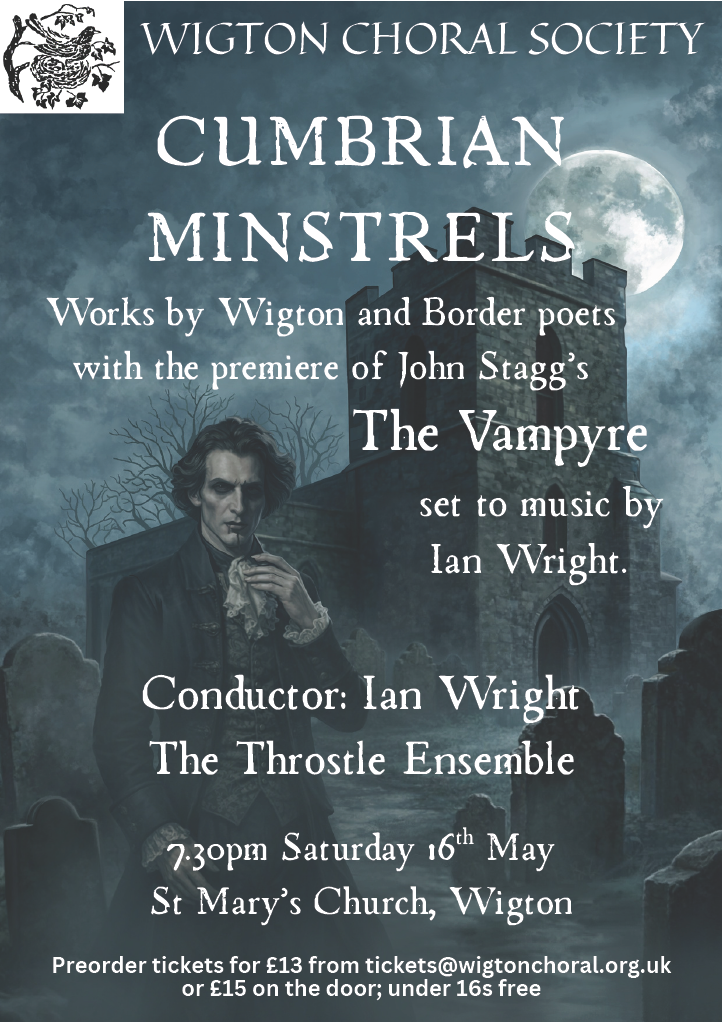
Cumbrian Minstrels
7.30 pm on Saturday 16th May 2026 in St. Mary’s Church, Wigton
Our Summer Concert this year celebrated the works of poets and writers with a Cumberland connection.
Review
Our thanks go to Helen Hutchinson for the following review of our concert.
Cumbrian Minstrels, performed by Wigton Choral Society
St Mary’s Church, Wigton Saturday 16th May 2026
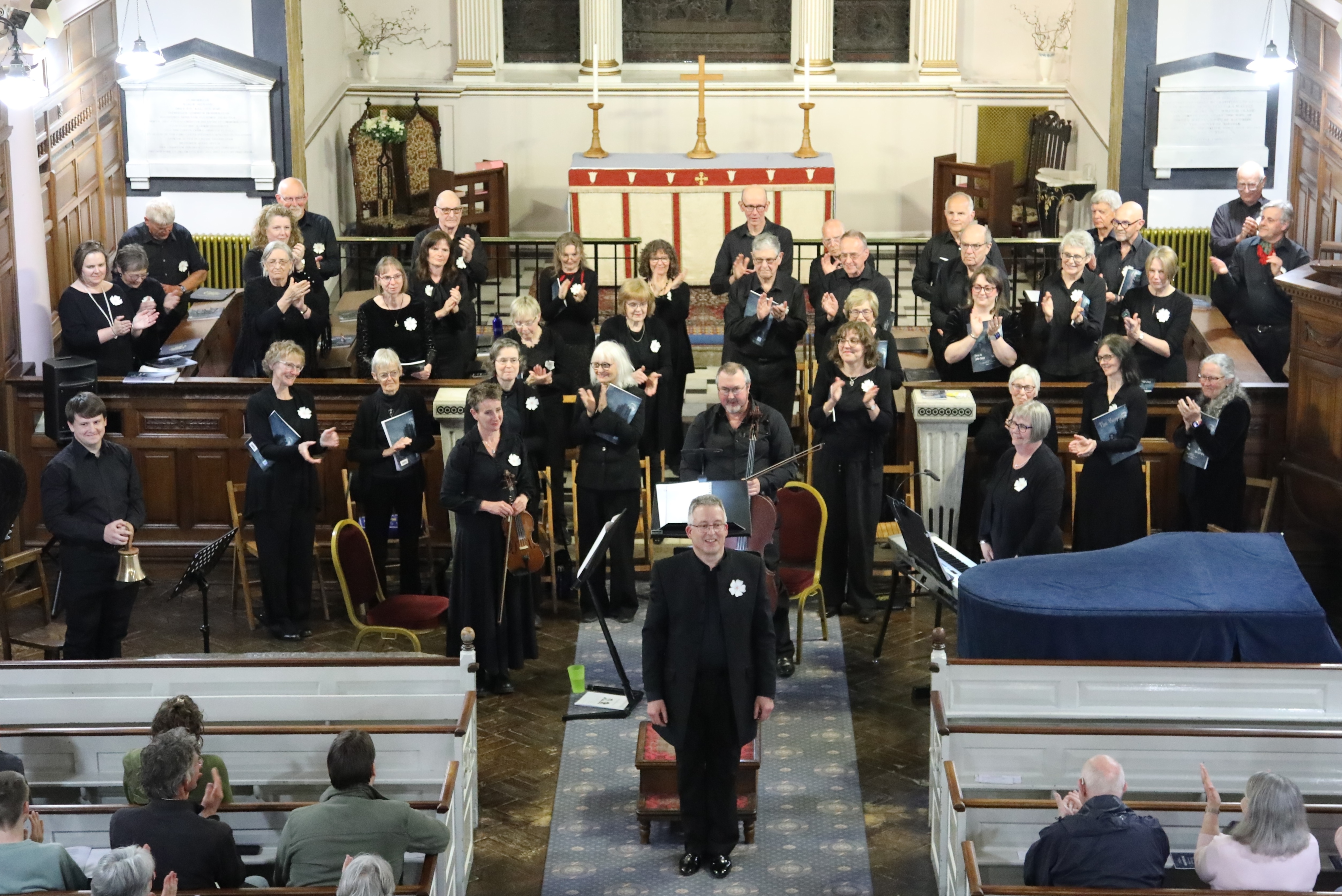
The elegant Georgian interior of St Mary’s Church, Wigton was the perfect setting for a concert celebrating poetry and music either composed in, or closely linked to the Cumberland of the late 18th and early 19th centuries. And Wigton Choral Society, all wearing badges of the Cumberland ‘Bog Star’ flower, were clearly enjoying the occasion.
Under the direction of Ian Wright, the choir performed a wide range of songs with texts by Cumberland’s vernacular poets, along with works by Robert Burns and William Wordsworth. The highlight of the concert was the première of Ian Wright’s own dramatic setting of The Vampyre, a thirty-eight verse saga written in 1810, and said to be the first entire British work on the subject. The author was poet and fiddle player John Stagg, born locally at Burgh by Sands, and known as “The Blind Bard of Wigton”.
The programme had been thoughtfully planned to make the most of the links and connections characterising a remarkably rich period of poetic and musical flourishing in this part of the world two hundred years ago. Along with the work of John Stagg, there were also settings of poems by Susanna Blamire, known as “The Muse of Cumberland”, and Robert Anderson, “The Cumberland Bard”.
Both Stagg and Anderson were born in 1770, the same year as William Wordsworth and Ludwig van Beethoven. Robert Burns and Susanna Blamire were born a little earlier in the mid 1700s, but their early lives coincided with that of the Austrian Josef Haydn. It came as a surprise to this reviewer at least to learn that it was common practice at that time for composers to be commissioned to write musical settings of poetry. So we were treated to hearing the choir sing Haydn’s settings of poems by Susana Blamire, and Beethoven’s take on songs of Robert Burns.
The concert opened with the Beethoven/Burns combination, re-worked for choir, piano and strings by Ian Wright. Pianist Amanda Wright, violinist Sandie Bishop and cellist Ed Pendrous provided movingly sensitive and supportive playing to accompany the warm full sound of the choir. The arrangements allowed the singers to enjoy the melodic lines, with a some very effective passages where the men’s voices sang in drone style reminiscent perhaps of bagpipes. Then followed a contemporary setting of Burns’ Craigieburn Wood by Cumbrian composer Carolyn Sparey, in which Ian Wright’s clear and precise conducting brought the best out in the singers. Two Susanna Blamire poems set to music by Haydn followed, with warm harmonies and a lovely blend in the choir interspersed with the clarity and precision of the strings and piano.
What followed was a complete change in the sound world, with contemporary Canadian composer Harold East’s 2003 setting of works by Wordsworth. Here individual voice parts were allowed to come to the fore to great effect, with a lovely variation in tone and character between the three movements. The first half ended on a high with the rumbustious Cumberland song D’ye ken John Peel? performed with gusto and clear enjoyment.
The second half opened with Ian Wright’s own arrangement of Canny Cummerlan’ by Robert Anderson with some pleasing harmonies for upper and lower voices. It was followed by an excellent short talk by choir member Dr Sue Allan, an expert on Cumbria’s folk tradition and the publisher of a biography of Robert Anderson. Sue took the audience on a whistle stop tour of the lives of Anderson, Blamire and Stagg, pointing out that Stagg himself worked within a stones throw of the church where we were sitting. It all added to the richness of the evening’s experience.
So to the finale, Ian Wright’s composition for choir, strings and piano of The Vampyre, a hideously graphic and gothic account of a man haunted and eventually killed by a former friend. Complete with scary tremolo passages on the violin, menacing cello and piano tones, and a gloomy bell toll, the piece had all the drama of a Hammer Horror movie soundtrack, and despite the subject matter, was clearly relished by the singers.
Cumbrian Minstrels was a delightful programme celebrating Cumberland’s rich heritage, performed with accomplishment and warmth by Wigton Choral Society and guests.
Review by Helen Hutchinson
 |
|---|
| Wigton Choral Society Concert, May 2026 |
Concert flyer and poster
A pdf copy of our flyer can be downloaded here.